
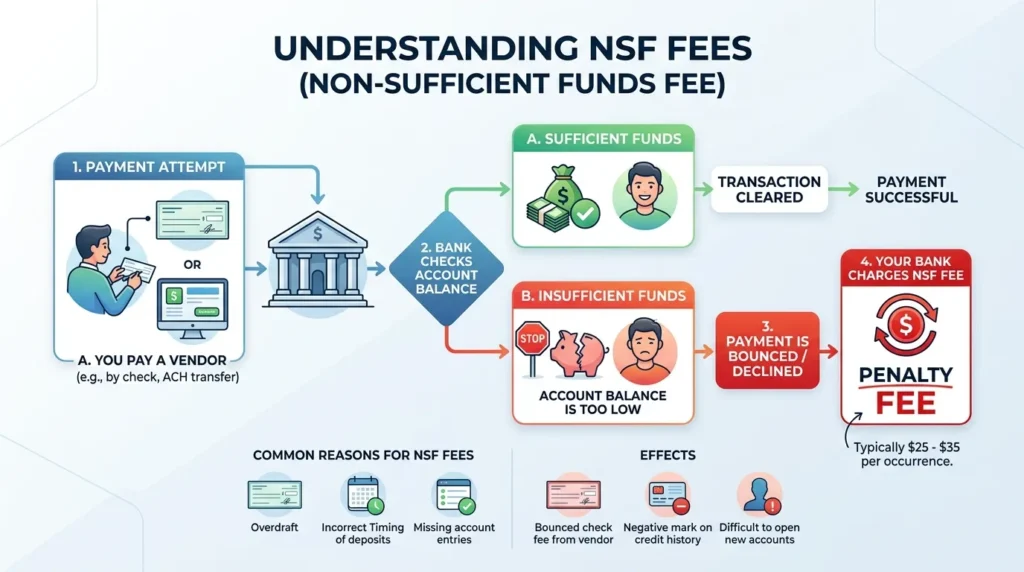
Have you ever checked your bank account, noticed a charge labeled “NSF Fee,” and wondered what it meant?
You’re not alone. Many people see this term for the first time after making a purchase, paying a bill, or reviewing their monthly bank statement. At first glance, it looks like banking jargon that’s difficult to understand.
The good news is that NSF fee is actually a common banking term, and once you know what it means, it’s easy to understand why it appears and how you can avoid it in the future.
Quick Answer:
NSF Fee means “Non-Sufficient Funds Fee.” It’s a banking fee charged when you don’t have enough money in your account to cover a payment, check, or automatic withdrawal.
What Does NSF Fee Mean in Text?
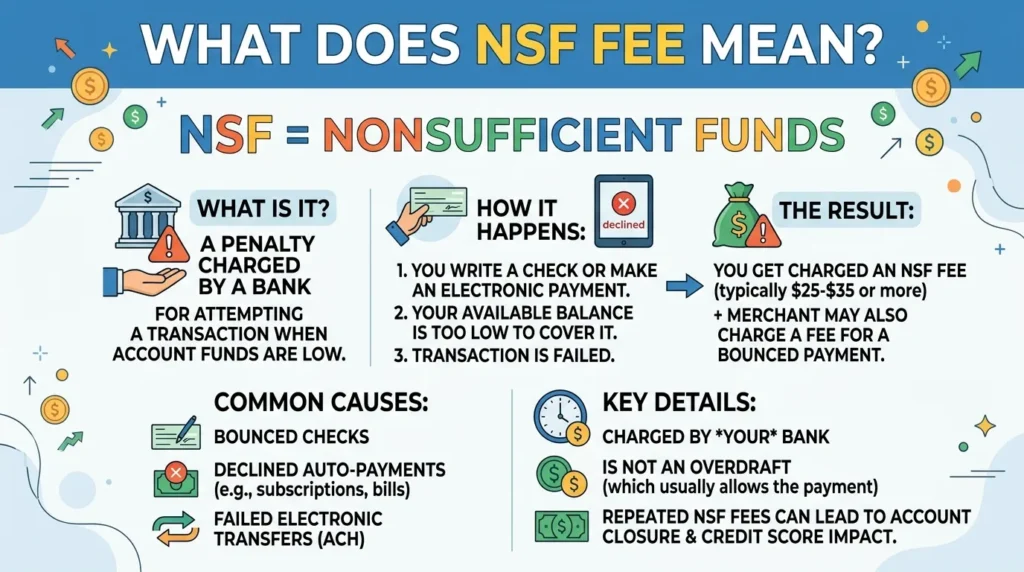
NSF Fee stands for Non-Sufficient Funds Fee.
Banks and credit unions charge this fee when your account balance isn’t high enough to complete a transaction. Instead of processing the payment successfully, the bank declines it (or sometimes covers it temporarily and charges a fee).
For example:
Your account balance: $25
Purchase amount: $60
Result: The transaction can’t be completed because your funds are insufficient, so the bank may charge an NSF fee.
Example
“I forgot my gym payment was due, and my bank charged me a $35 NSF fee.”
This simply means the account didn’t have enough money to pay the bill.
In short: NSF Fee = Non-Sufficient Funds Fee = A bank charge for not having enough money in your account.
Where Is NSF Fee Commonly Used?
Although NSF Fee isn’t internet slang like “LOL” or “BRB,” it’s commonly seen in financial conversations and banking.
You’ll often find it in:
- 💳 Bank account statements
- 📱 Mobile banking apps
- 💻 Online banking websites
- 💬 Customer service chats
- 📧 Bank notification emails
- 📄 Monthly account statements
- 💰 Automatic payment alerts
Tone
- ✅ Financial and professional
- ✅ Banking terminology
- ❌ Not casual texting slang
- ❌ Not flirty or social-media slang
Most people encounter NSF Fee while managing their finances rather than chatting with friends.
Examples of NSF Fee in Conversation
Here are some realistic examples of how people use NSF Fee in everyday conversations.
Example 1
A: why is my bank balance lower today? 🤔
B: looks like you got charged an NSF fee.
Example 2
A: my rent payment didn’t go through.
B: you probably didn’t have enough funds and got an NSF fee.
Example 3
A: what’s this $35 charge?
B: that’s an NSF fee from your bank.
Example 4
A: i forgot payday was tomorrow 😭
B: hopefully you avoided an NSF fee.
Example 5
A: my check bounced.
B: yeah, that usually comes with an NSF fee.
Example 6
A: i need to keep more money in my account.
B: it’ll help you avoid future NSF fees.
When to Use and When Not to Use NSF Fee
✅ When To Use
Use NSF Fee when discussing:
- Bank accounts
- Checking account balances
- Overdraft situations
- Failed payments
- Bounced checks
- Automatic bill payments
- Personal finance
❌ When Not to Use
Avoid using NSF Fee when:
- Talking with friends about everyday topics
- Posting on social media unrelated to money
- Writing casual messages
- Flirting or joking
- Discussing non-financial subjects
Usage Comparison
| Context | Example Phrase | Why It Works |
|---|---|---|
| Friend Chat | “I got hit with an NSF fee 😩” | Casual discussion about banking |
| Family Chat | “Watch your balance so you don’t get an NSF fee.” | Helpful financial advice |
| Work Chat | “My payment was delayed because of an NSF fee.” | Professional explanation |
| “The payment failed due to an NSF fee.” | Clear and formal |
Similar Banking Terms or Alternatives
| Term | Meaning | When to Use |
|---|---|---|
| NSF | Non-Sufficient Funds | General banking discussions |
| Overdraft Fee | Fee for spending more than your balance | When overdraft protection is used |
| Bounced Check | Check returned because of insufficient funds | Paper check payments |
| Returned Payment | Payment rejected by the bank | Automatic withdrawals |
| Insufficient Funds | Not enough money available | General financial situations |
| Declined Transaction | Payment wasn’t approved | Debit or credit card purchases |
Why Do Banks Charge NSF Fees?
Banks charge NSF fees because processing failed transactions involves administrative work and financial risk.
Common reasons include:
- Forgetting about automatic bill payments
- Writing a check without enough money
- Making purchases before payday
- Multiple payments leaving the account at once
- Miscalculating your available balance
Depending on your bank, NSF fees can range from around $20 to $40 per transaction, although some financial institutions have reduced or eliminated these fees in recent years.
How to Avoid NSF Fees
Avoiding NSF fees is easier than paying them.
Here are some practical tips:
- 💰 Keep a small emergency balance in your checking account.
- 📲 Enable low-balance alerts through your banking app.
- 📅 Track automatic payments and subscriptions.
- 📊 Review your account regularly.
- 💳 Link a savings account for overdraft protection if available.
- 🧾 Record checks and pending payments.
- 📈 Maintain a spending budget.
These habits can significantly reduce the chance of unexpected NSF charges.
Is an NSF Fee the Same as an Overdraft Fee?
Not exactly.
Although they’re closely related, they aren’t identical.
| NSF Fee | Overdraft Fee |
|---|---|
| Payment is usually declined | Payment is approved despite insufficient funds |
| No money leaves the account | Bank temporarily covers the payment |
| Charged for a returned transaction | Charged for overdraft coverage |
| Common with checks and ACH payments | Common with debit card transactions |
Some banks may use different policies, so it’s always worth checking your account agreement.
FAQs About NSF Fee
What does NSF Fee stand for?
It stands for Non-Sufficient Funds Fee.
Why was I charged an NSF fee?
Because your account didn’t have enough money to complete a payment or withdrawal.
Is an NSF fee a penalty?
Yes. It’s a banking charge for a failed transaction caused by insufficient funds.
How much is an NSF fee?
The amount varies by bank, but many charge between $20 and $40.
Can an NSF fee be refunded?
Sometimes. If it’s your first occurrence or you have a good banking history, your bank may reverse the fee if you ask.
Does an NSF fee hurt my credit score?
Generally, no. However, unpaid bank fees sent to collections could eventually affect your credit.
Is NSF the same as insufficient funds?
Yes. NSF is simply the abbreviation for Non-Sufficient Funds.
Can I avoid NSF fees?
Yes. Monitoring your balance, setting account alerts, and maintaining extra funds can help prevent them.
Conclusion
NSF Fee means Non-Sufficient Funds Fee, a charge banks may apply when your account doesn’t have enough money to cover a payment. While seeing this fee can be frustrating, understanding what it means makes it much easier to manage your finances and avoid future charges.
By keeping track of your account balance, planning bill payments, and using banking alerts, you can reduce the chances of ever seeing an NSF fee again.

Nova HN is a creative writer at snamez.com, crafting unique and engaging content focused on names, nicknames, and innovative ideas.