
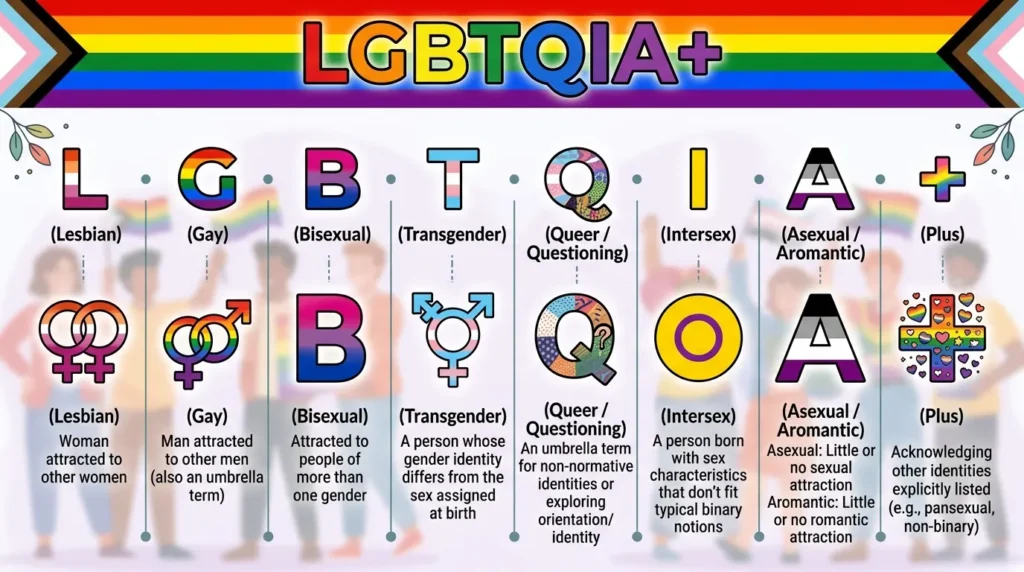
If you’ve ever wondered what does LGBTQIA mean, you’re not alone.
Millions of people search this question every year because they see the term on social media, in news articles, schools, workplaces, and everyday conversations.
Understanding LGBTQIA helps you communicate respectfully and better understand different identities and communities.
Whether you’re curious, supporting a friend, or simply learning something new, this guide explains everything in simple language.
In this article, you’ll learn what each letter in LGBTQIA stands for, why the “+” symbol matters, the history behind the acronym, common myths, frequently asked questions, and how to be respectful when talking about LGBTQIA people.
🌈 What Does LGBTQIA Mean?
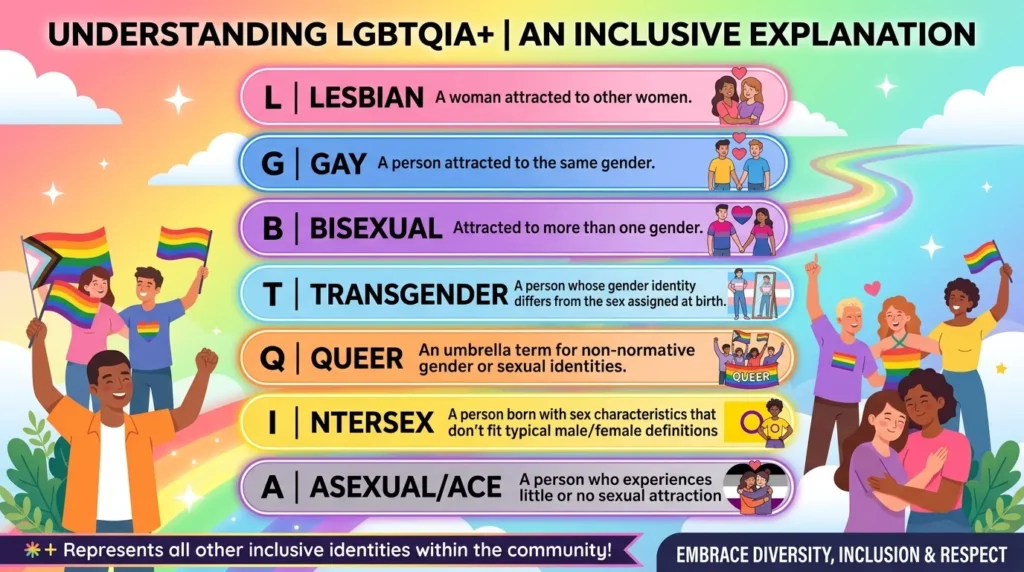
LGBTQIA is an acronym that represents different sexual orientations, gender identities, and gender expressions.
Here’s what each letter means:
- L = Lesbian
- G = Gay
- B = Bisexual
- T = Transgender
- Q = Queer or Questioning
- I = Intersex
- A = Asexual, Aromantic, or Agender
- + = Other identities not included in the main letters
The acronym continues to grow because language changes over time, and more people are recognized and represented.
🏳️ What Does L Stand For? (Lesbian)
A lesbian is a woman who is emotionally, romantically, or sexually attracted to other women.
Key facts
- A sexual orientation
- Women loving women
- Can describe both identity and community
- Many lesbians use different labels based on personal preference
💙 What Does G Stand For? (Gay)
Gay usually refers to men who are attracted to other men, but some women also use the word gay to describe themselves.
Key facts
- One of the oldest widely used LGBTQIA terms
- Refers to sexual orientation
- Commonly used worldwide
💜 What Does B Stand For? (Bisexual)
Bisexual means a person may be attracted to more than one gender.
This does not mean equal attraction to every gender. Attraction is personal and different for everyone.
Common misconceptions
- Bisexual people are not “confused.”
- Being bisexual does not mean someone must date multiple people.
- Bisexuality is a valid sexual orientation.
⚧️ What Does T Stand For? (Transgender)
A transgender person has a gender identity that is different from the sex assigned to them at birth.
Gender identity is about who someone is—not who they are attracted to.
Examples include:
- Trans men
- Trans women
- Some non-binary people also identify under the transgender umbrella, while others do not.
❓ What Does Q Stand For? (Queer or Questioning)
The letter Q has two common meanings.
Queer
Many people proudly use “queer” as an umbrella term for diverse sexual orientations and gender identities.
Questioning
Some people are still exploring their identity and may identify as questioning while they learn more about themselves.
🧬 What Does I Stand For? (Intersex)
Intersex people are born with natural variations in sex characteristics.
These differences may involve chromosomes, hormones, reproductive organs, or anatomy.
Important facts:
- Intersex is about biological traits.
- It is different from sexual orientation.
- It is different from gender identity.
🖤 What Does A Stand For? (Asexual, Aromantic, or Agender)
The letter A can represent several identities.
Asexual
A person who experiences little or no sexual attraction.
Aromantic
Someone who experiences little or no romantic attraction.
Agender
A person who does not identify with any gender.
These identities are all valid and unique.
➕ What Does the Plus (+) Mean?
The plus sign recognizes identities that are not specifically listed in LGBTQIA.
Examples include:
- Non-binary
- Genderfluid
- Two-Spirit
- Pansexual
- Demisexual
- And many others
The “+” helps make the acronym more inclusive.
📖 A Brief History of LGBTQIA
The LGBTQIA acronym has changed over time.
Earlier versions included:
- Gay
- Gay and Lesbian
- LGBT
- LGBTQ
- LGBTQIA
- LGBTQIA+
As society learned more about gender and sexuality, the acronym expanded to include more communities.
Today, LGBTQIA+ is one of the most commonly used versions around the world.
❤️ Sexual Orientation vs Gender Identity
Many people confuse these two ideas.
Sexual Orientation
Who someone is emotionally or romantically attracted to.
Examples:
- Gay
- Lesbian
- Bisexual
- Asexual
Gender Identity
How someone identifies their own gender.
Examples:
- Woman
- Man
- Transgender
- Non-binary
- Agender
These are different concepts.
🤝 Why Is LGBTQIA Representation Important?
Representation helps people feel seen and respected.
Benefits include:
- Better understanding
- Reduced stereotypes
- More inclusive schools
- Safer workplaces
- Greater acceptance
When people learn about different identities, communities become more welcoming.
💡 Common Myths About LGBTQIA
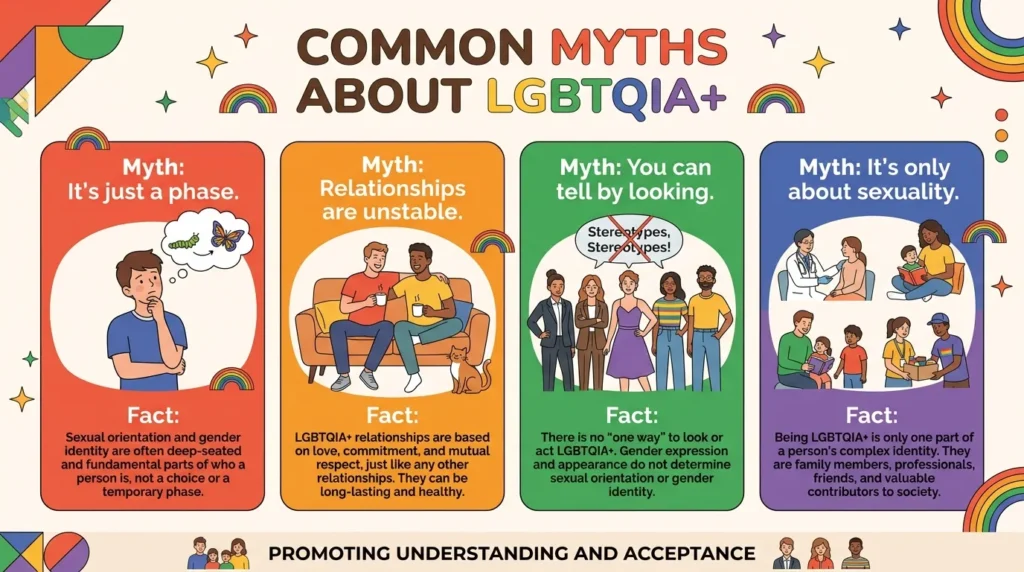
Myth 1: LGBTQIA is a choice.
Fact: Sexual orientation and gender identity are widely understood as aspects of who a person is, not choices.
Myth 2: Everyone in LGBTQIA is the same.
Fact: Every person has a unique experience.
Myth 3: The acronym keeps changing for no reason.
Fact: Language evolves to better represent different communities.
Myth 4: Gender identity and sexual orientation are the same.
Fact: They are different concepts.
🌟 How to Be Respectful
You don’t need to know everything to be respectful.
Simple ways include:
- Listen without judging.
- Use the names and pronouns people ask you to use.
- Avoid making assumptions.
- Ask respectful questions when appropriate.
- Keep learning.
Kindness and respect matter most.
❓ Frequently Asked Questions
Is LGBTQIA the same as LGBTQ+?
LGBTQIA includes additional identities, while LGBTQ+ uses the plus sign to represent many identities.
What does the “+” include?
It represents identities beyond the listed letters.
Is “queer” always offensive?
No. Many people proudly use it, while others prefer different labels. Respect individual preferences.
Can someone belong to more than one identity?
Yes. Some people identify with multiple aspects of the LGBTQIA+ community.
Why should I learn about LGBTQIA?
Learning helps create respectful conversations and better understanding of others.
Conclusion
Now you know the answer to what does LGBTQIA mean. Each letter represents different identities within a diverse community, while the “+” recognizes many additional identities. Understanding these terms can make conversations more respectful and inclusive.
Whether you’re learning for school, work, supporting a friend, or simply satisfying your curiosity, taking time to understand LGBTQIA is a positive step. Keep learning, ask respectful questions, and remember that every person’s identity and experience is unique.

Silent Quill is a creative writer at snamez.com, known for crafting meaningful and engaging content. Their work focuses on unique names, nicknames, and creative ideas that inspire and connect with readers.