
If you’ve ever picked up a bottle of whiskey, vodka, rum, or another spirit, you’ve probably noticed a number labeled as 80 proof, 100 proof, or even 151 proof.
Many people wonder, what does proof mean in alcohol? Does it tell you how strong the drink is?
Does higher proof mean better quality? And how does proof compare to alcohol percentage?
This guide answers all of those questions in simple language.
You’ll learn what alcohol proof means, how it is calculated, why it matters, and how it affects flavor, strength, and responsible drinking.
Whether you’re curious about spirits or simply want to understand the label on a bottle, this guide explains everything you need to know.
🥃 What Does Proof Mean in Alcohol?
Alcohol proof is a number that shows how much alcohol is in a drink. In the United States, the proof is twice the Alcohol by Volume (ABV).
Simple formula:
Proof = ABV × 2
For example:
- 40% ABV = 80 Proof
- 50% ABV = 100 Proof
- 60% ABV = 120 Proof
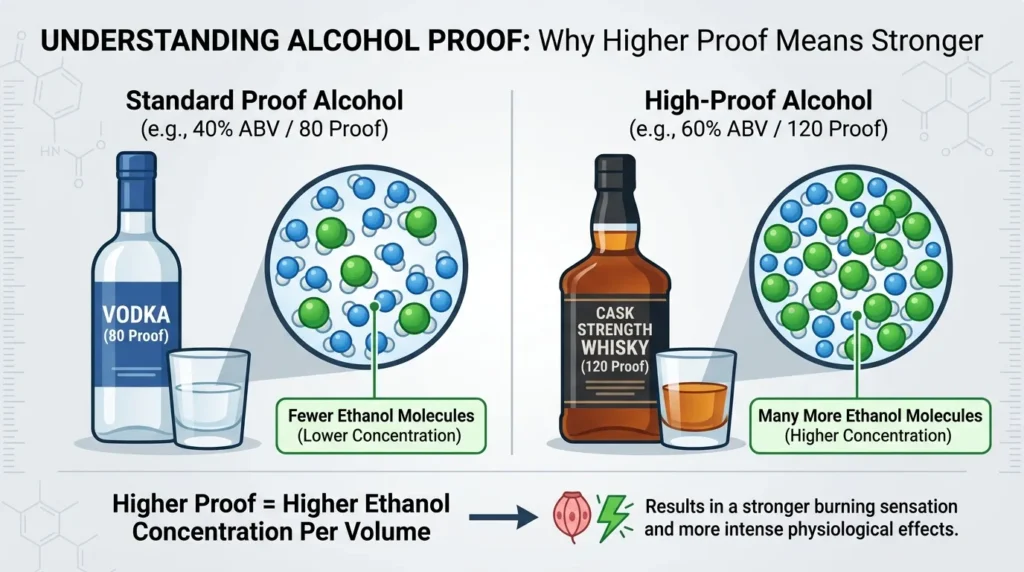
The higher the proof, the more alcohol the drink contains.
📖 What Is Alcohol by Volume (ABV)?
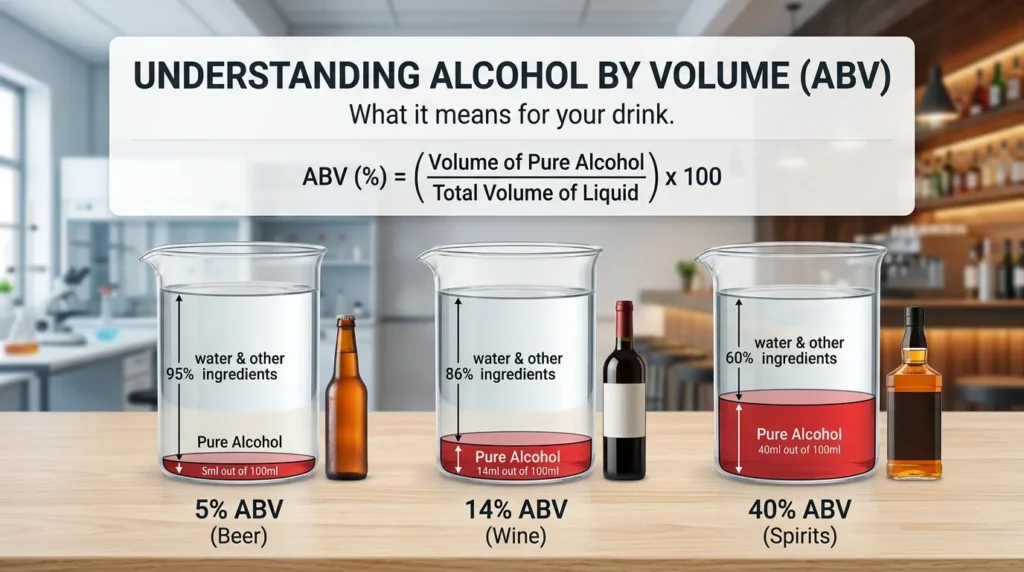
ABV stands for Alcohol by Volume. It measures the percentage of pure alcohol in a beverage.
Examples:
- Beer: 4–7% ABV
- Wine: 11–15% ABV
- Whiskey: Around 40% ABV
- Vodka: Around 40% ABV
- Rum: 40–75% ABV
ABV is used around the world because it gives an exact measurement of alcohol content.
🕰️ Where Did the Word “Proof” Come From?
The term “proof” comes from old England.
Many years ago, merchants needed a way to prove that liquor contained enough alcohol. They poured alcohol onto gunpowder and tried to light it.
- If the gunpowder burned, the alcohol was considered “proof.”
- If it did not burn, it contained too much water.
Today, this old method has been replaced by accurate scientific testing.
🔢 How Do You Calculate Alcohol Proof?
The calculation is very simple in the United States.
Formula:
Proof = ABV × 2
Examples:
| ABV | Proof |
|---|---|
| 35% | 70 Proof |
| 40% | 80 Proof |
| 45% | 90 Proof |
| 50% | 100 Proof |
| 57% | 114 Proof |
| 75.5% | 151 Proof |
If you know the proof, divide it by two to find the ABV.
Example:
100 Proof ÷ 2 = 50% ABV
🌍 Does Every Country Use Proof?
No.
Many countries only use ABV.
For example:
- United States: Uses both Proof and ABV.
- Canada: Mostly uses ABV.
- United Kingdom: Uses ABV.
- Australia: Uses ABV.
- European countries: Use ABV.
ABV has become the international standard because it is easier to understand.
🍸 Common Alcohol Proof Levels
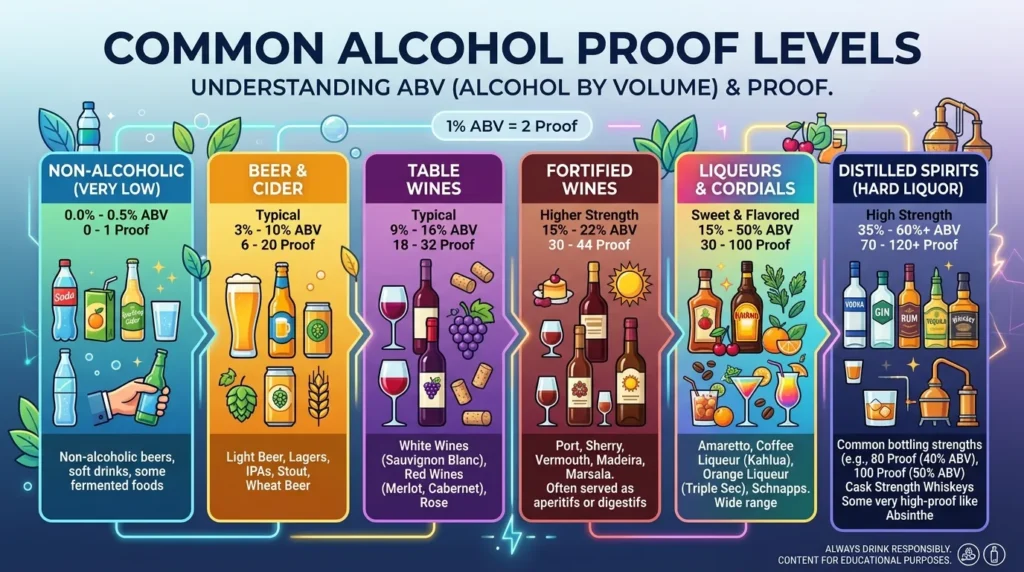
Different drinks have different proof levels.
80 Proof
- 40% ABV
- Common for vodka, whiskey, tequila, rum, and gin.
90 Proof
- 45% ABV
- Slightly stronger than standard spirits.
100 Proof
- 50% ABV
- Popular for some bourbons and rye whiskeys.
151 Proof
- 75.5% ABV
- Extremely strong and should be consumed with caution.
🥃 Does Higher Proof Mean Better Alcohol?
No.
Higher proof only means there is more alcohol.
Quality depends on many factors, including:
- Ingredients
- Distillation process
- Aging
- Flavor
- Craftsmanship
Some of the world’s best spirits are only 80 proof, while some very high-proof drinks are made mainly for cocktails or special uses.
😋 How Does Proof Affect Flavor?
Proof changes the drinking experience.
Lower-proof spirits often taste:
- Smoother
- Less intense
- Easier for beginners
Higher-proof spirits usually taste:
- Stronger
- Richer
- More concentrated
- Warmer on the throat
Many enthusiasts add a few drops of water to high-proof whiskey to open up the flavors.
⚠️ Why Is High-Proof Alcohol Stronger?
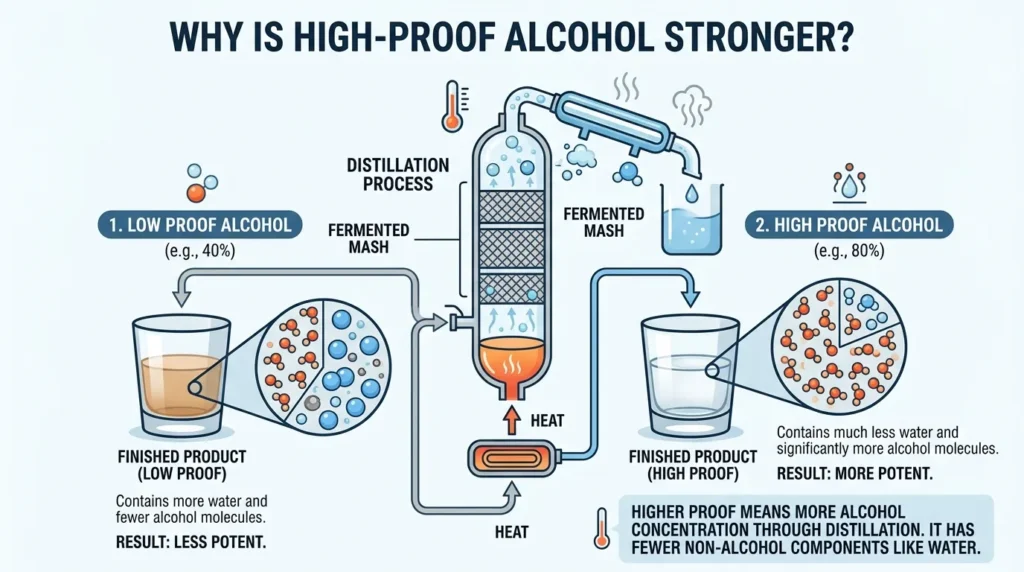
High-proof alcohol contains more ethanol.
This means it can:
- Affect the body more quickly.
- Increase intoxication faster.
- Cause stronger burning sensations.
- Increase the risk of alcohol poisoning if consumed excessively.
Because of this, higher-proof drinks should be consumed responsibly.
🍹 Examples of Popular Spirits and Their Proof
Here are some common examples.
| Drink | Typical ABV | Typical Proof |
|---|---|---|
| Vodka | 40% | 80 Proof |
| Whiskey | 40–50% | 80–100 Proof |
| Bourbon | 40–50% | 80–100 Proof |
| Gin | 40–47% | 80–94 Proof |
| Rum | 40–75.5% | 80–151 Proof |
| Tequila | 38–40% | 76–80 Proof |
🤔 Is 100 Proof Twice as Strong as 50 Proof?
Not exactly.
Remember:
- 100 Proof = 50% ABV
- 50 Proof = 25% ABV
So yes, a 100-proof drink contains about twice the alcohol concentration of a 50-proof drink. However, how alcohol affects someone depends on many factors, including body size, food intake, and drinking speed.
❓ Frequently Asked Questions
What does 80 proof mean?
It means the drink contains 40% alcohol by volume.
Is proof the same as alcohol percentage?
No.
Proof is simply another way of expressing alcohol content. In the U.S., proof is double the ABV.
Why is alcohol called proof?
The name comes from an old test using gunpowder to “prove” the strength of spirits.
Is higher proof always better?
No. It only means more alcohol, not higher quality.
What is the strongest commonly sold proof?
Some overproof spirits reach 151 proof, while a few specialty products can be even stronger.
Final Thoughts
Understanding what proof means in alcohol is easier than it first appears. In the United States, proof is simply twice the Alcohol by Volume (ABV). An 80-proof bottle contains 40% alcohol, while a 100-proof bottle contains 50%.
Knowing the proof helps you compare drinks, understand their strength, and make informed choices. However, remember that proof measures alcohol content not quality or taste. Whether you enjoy a standard 80-proof spirit or a stronger overproof option, responsible drinking is always the best approach.

Emily Dickinson is a creative and thoughtful writer at snamez.com, crafting unique names, nicknames, and inspiring ideas for readers.