

Have you ever heard the word composition in school, art, music, writing, photography, or everyday conversations and wondered what it actually means? You’re not alone.
Many people search for “what does composition mean” because the term appears in many different subjects and contexts.
While the basic idea remains similar, its meaning can change depending on where it is used.
Understanding composition can help you become a better writer, artist, musician, photographer, student, and communicator.
Whether you’re completing a school assignment, learning photography, studying literature, or simply expanding your vocabulary, knowing the meaning of composition is incredibly useful.
In this comprehensive guide, we’ll explore the definition of composition, its origins, different meanings across various fields, practical examples, and why composition plays such an important role in everyday life.
By the end of this article, you’ll have a clear understanding of what composition means and how it is used in different situations.
📖 What Does Composition Mean?

The word composition refers to the way something is created, arranged, or put together. It describes the structure, organization, or combination of different elements that form a complete whole.
Simple Definition
Composition means the arrangement of parts or elements to create a unified whole.
The term comes from the Latin word componere, which means “to put together.”
Example:
- A writer arranges words and sentences to create an essay.
- A photographer arranges visual elements in a picture.
- A musician arranges notes and sounds to create music.
In all these cases, composition refers to how the different parts work together.
✍️ Composition in Writing
One of the most common uses of the word composition is in writing.
In education, a composition is a piece of writing that expresses ideas, thoughts, or information in an organized way.
Types of Writing Composition
Narrative Composition
Tells a story or describes events.
Descriptive Composition
Creates a detailed picture using words.
Expository Composition
Explains information or concepts.
Persuasive Composition
Attempts to convince readers of a particular viewpoint.
Example
If a student writes an essay about climate change, that essay is considered a composition because it organizes ideas into a structured format.
🎨 Composition in Art
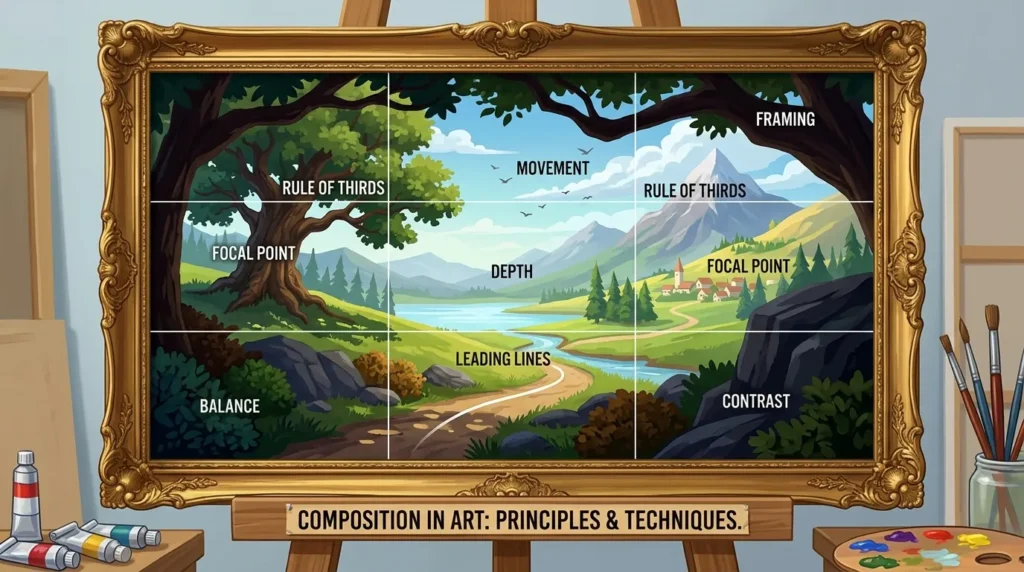
In art, composition refers to how visual elements are arranged within a piece of artwork.
Artists carefully place shapes, colors, lines, and objects to guide the viewer’s attention.
Elements of Artistic Composition
- Balance
- Contrast
- Unity
- Emphasis
- Proportion
- Movement
A well-composed painting feels organized and visually pleasing, while a poor composition may appear confusing or cluttered.
📸 Composition in Photography
Photography composition is the arrangement of visual elements within a photograph.
Good composition helps photographers create images that attract attention and tell a story.
Common Photography Composition Techniques
Rule of Thirds
Dividing an image into nine equal sections and placing subjects along the lines.
Leading Lines
Using roads, paths, or lines to direct the viewer’s eyes.
Framing
Using objects around the subject to create focus.
Creating balance through mirrored elements.
Strong photographic composition can transform an ordinary picture into a stunning image.
🎵 Composition in Music
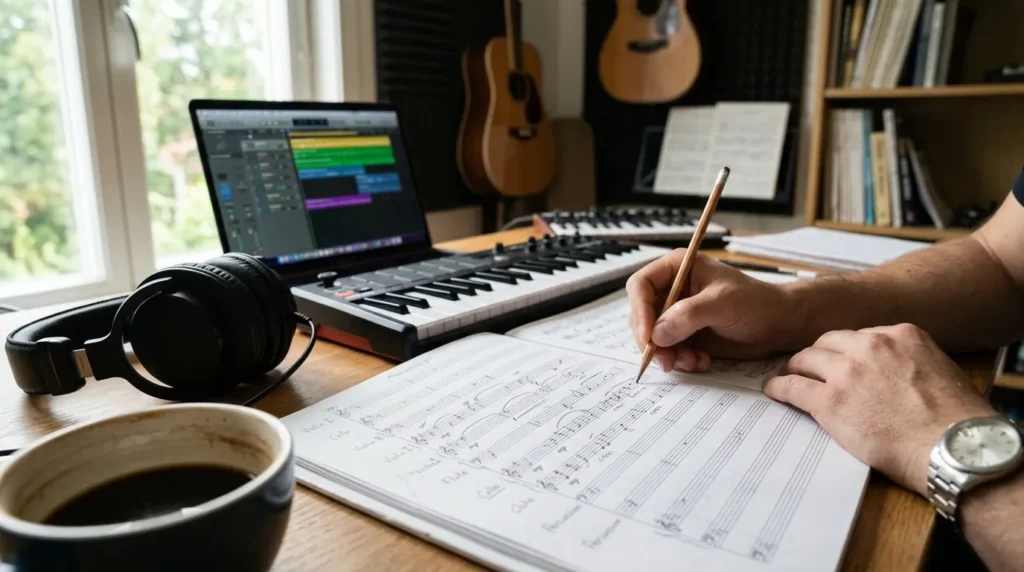
In music, composition refers to the process of creating and arranging musical notes, rhythms, melodies, and harmonies.
A musical composition can be:
- A song
- A symphony
- A piano piece
- An instrumental work
What Does a Music Composer Do?
A composer:
- Creates melodies
- Chooses harmonies
- Organizes musical structure
- Develops rhythms
Every song you hear started as a musical composition before being performed or recorded.
🧪 Composition in Science
In science, composition refers to the substances or materials that make up something.
Examples
- The composition of air includes oxygen, nitrogen, and other gases.
- The composition of water is hydrogen and oxygen.
- The composition of soil includes minerals, organic matter, water, and air.
Scientists use composition to understand what objects, materials, or substances contain.
🏫 Composition in Education

Students often encounter composition assignments in school.
These tasks help develop:
- Writing skills
- Critical thinking
- Organization
- Creativity
- Communication
Why Teachers Assign Compositions
Teachers use composition exercises to evaluate how well students can:
- Express ideas
- Organize information
- Support arguments
- Use proper grammar
Composition writing remains one of the most important academic skills.
🏛️ Composition in Literature
In literature, composition refers to the structure and organization of a written work.
Authors carefully plan:
- Characters
- Plot
- Themes
- Settings
- Narrative style
Literary Composition Examples
A novel’s composition includes:
- Beginning
- Middle
- Climax
- Resolution
Effective literary composition keeps readers engaged from start to finish.
🏗️ Why Composition Is Important
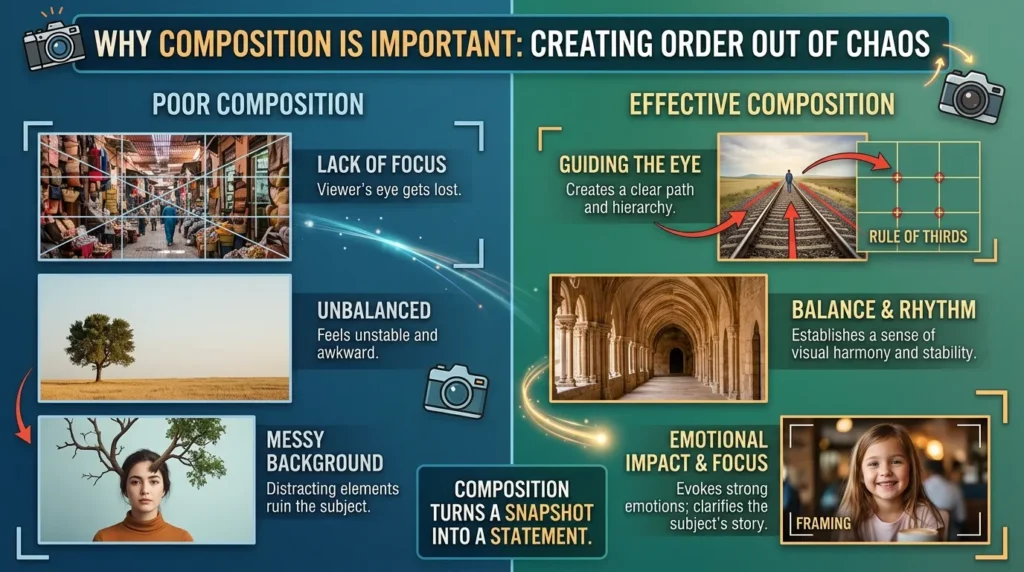
Composition matters because organization affects how people understand information.
Whether in writing, art, music, or photography, composition helps create clarity and impact.
Benefits of Good Composition
Better Communication
Ideas become easier to understand.
Stronger Visual Appeal
Images and artwork look more attractive.
Greater Emotional Impact
Well-organized content creates stronger reactions.
Improved Professional Quality
Projects appear polished and complete.
Without composition, information and creativity can feel disorganized or ineffective.
🔍 Examples of Composition in Everyday Life
Many people use composition without realizing it.
Everyday Examples
Cooking
Ingredients are arranged into a recipe.
Interior Design
Furniture is arranged within a room.
Presentations
Information is organized into slides.
Social Media Posts
Text, images, and videos are combined effectively.
Websites
Content and design elements are arranged for user experience.
These examples show how composition influences daily activities.
⚖️ Composition vs Structure: What’s the Difference?

Many people confuse composition and structure.
Although related, they are not exactly the same.
Composition
Focuses on how parts are arranged together.
Structure
Focuses on the framework or organization supporting the arrangement.
Example
In an essay:
- Structure refers to introduction, body, and conclusion.
- Composition refers to how ideas, paragraphs, and sentences work together.
Both are important, but composition often involves a broader creative process.
🌍 Different Meanings of Composition Around the World
The word composition is used internationally across many industries and educational systems.
Common Global Uses
- Academic writing
- Fine arts
- Graphic design
- Music production
- Scientific research
- Photography
- Architecture
Because composition is a universal concept, understanding it can help in many careers and fields of study.
🚀 How to Improve Your Composition Skills

No matter the field, strong composition skills can be developed with practice.
Tips for Better Composition
Plan Before Creating
Think about organization first.
Focus on Balance
Ensure all elements work together.
Remove Unnecessary Parts
Keep only what supports your goal.
Study Good Examples
Learn from professionals.
Practice Regularly
Improvement comes through repetition.
Whether you’re writing essays, taking photos, or creating artwork, composition improves with experience.
💼 Careers That Use Composition
Many professions rely heavily on composition skills.
Popular Careers
- Writer
- Journalist
- Photographer
- Graphic Designer
- Artist
- Music Composer
- Architect
- Teacher
- Marketing Specialist
- Content Creator
Understanding composition can provide a valuable advantage in these careers.
❓ Common Questions About Composition
Is Composition the Same as Writing?
Not exactly. Writing composition is one form of composition, but the term applies to many fields.
What Is a School Composition?
A school composition is an organized piece of writing completed by a student.
Why Is Composition Important in Photography?
Composition helps guide attention and create visually appealing images.
What Does Composition Mean in Science?
It refers to the substances or materials that make up something.
Can Anyone Improve Composition Skills?
Yes. Practice, observation, and learning basic principles can significantly improve composition abilities.
Conclusion
So, what does composition mean? In its simplest form, composition is the arrangement of elements to create a complete and meaningful whole. Whether you’re writing an essay, taking a photograph, creating artwork, composing music, or studying science, composition plays a vital role in how information and ideas are organized.
Understanding composition helps improve communication, creativity, and problem-solving skills. It allows people to present their ideas clearly, create visually appealing designs, and develop more effective projects. Because composition is used in so many different areas of life, learning its principles can benefit students, professionals, artists, and creators alike.
The next time you encounter the word composition, you’ll know that it is all about how different parts come together to form something meaningful, organized, and impactful.
This draft is optimized around the keyword “what does composition mean” with clear headings, SEO-friendly structure, and user-focused explanations.

Emily Dickinson is a creative and thoughtful writer at snamez.com, crafting unique names, nicknames, and inspiring ideas for readers.